Showing posts with label Frontend and Backend. Show all posts

Sunday, June 15, 2025

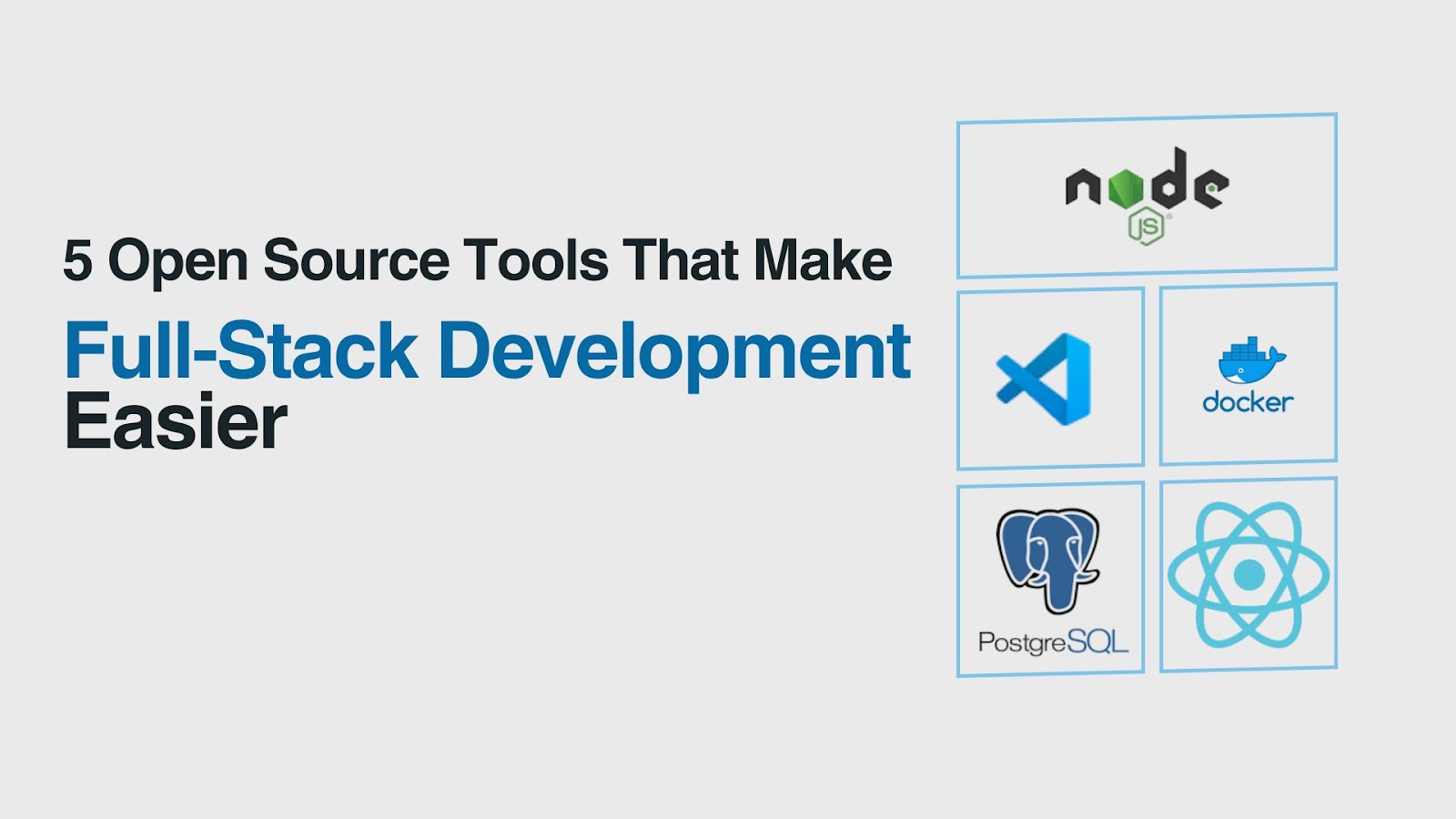
5 Open Source Tools That Make Full-Stack Development Easier


If you're diving into full-stack development in 2025, you're already familiar with its complexity, and switching between frontend frameworks, backend APIs, databases, and deployment pipelines can feel like juggling fire. Fortunately, there are open-source tools built specifically to make full-stack development not just manageable but actually enjoyable.

These tools save time, reduce boilerplate code, and help teams focus on building better products faster.

Building scalable systems often means working across frontend, backend, and database layers seamlessly. We've broken down our full-stack development approach to show how each layer integrates into a maintainable and efficient whole.

1. VS Code – The Developer’s Swiss Army Knife

It’s hard to talk about open-source tools without mentioning Visual Studio Code (VS Code). Created by Microsoft and beloved by the global dev community, VS Code is more than just a code editor—it's an extensible development environment.

Why Developers Rely on It:

  • Multi-language support: From JavaScript and Python to Rust and Go, VS Code handles it all.

  • IntelliSense: Smart autocompletion and code suggestions reduce syntax errors and speed up coding.

  • Built-in Git integration: Makes version control simple and seamless.

  • Remote development: Connect to containers, WSL, or SSH servers as if they were local.

  • Extensions Marketplace: With over 30,000 extensions, you can create a tailor-made setup.

Did You Know? Over 74% of developers used VS Code in 2024, according to the Stack Overflow Developer Survey.

2. Node.js – The Heart of Modern Backend Logic

Originally seen as a frontend tool, Node.js revolutionized backend development by enabling JavaScript to run on servers. For full-stack developers, Node.js bridges the frontend-backend gap effortlessly.

Key Features:

  • Event-driven and non-blocking I/O: Perfect for high-performance APIs.

  • Massive npm ecosystem: 1.5 M+ packages for almost any functionality you need.

  • Microservice-friendly: Ideal for RESTful and GraphQL APIs.

  • Cross-platform support: Easily runs on Linux, macOS, and Windows.

🔗 Read more on how we use Node.js in backend projects in our Backend Services.

Node.js allows teams to write both frontend and backend in JavaScript, simplifying skill requirements and improving code reuse.

3. Docker – Containerize Everything

Ask any full-stack developer who's deployed to production, and they'll tell you that “it works on my machine” is a thing of the past—thanks to Docker.

Why It Matters:

  • Environment consistency: Eliminates OS, dependency, and version conflicts.

  • Lightweight containers: Run isolated services with minimal overhead.

  • CI/CD friendly: Easily integrates with Jenkins, GitHub Actions, or GitLab CI.

  • Portability: Build once, run anywhere.

Use Docker to package the frontend, backend, and database into separate containers, all linked together.

Tip: Combine Docker with Docker Compose for full-stack orchestration in a single docker-compose.yml file.

4. React – Building User Interfaces the Smart Way

When it comes to frontend frameworks, React dominates the landscape. Originally built by Facebook, this open-source library allows you to craft dynamic, component-based UIs with ease.

Benefits for Full-Stack Devs:

  • Reusable components: Build once, reuse everywhere.

  • Unidirectional data flow: Reduces bugs and improves clarity.

  • React Hooks: Simplify state and lifecycle management.

  • React Router: Enables clean SPA navigation.

  • Rich ecosystem: Pair with Redux, Next.js, or TypeScript.

At Bluell, our Frontend Development services lean heavily on React for building flexible, performant interfaces.

React isn’t just for the frontend—it integrates smoothly with backend APIs, WebSockets, and authentication flows.

5. PostgreSQL – Open Source Database You Can Trust

Your full-stack application needs a reliable, feature-rich database. Enter PostgreSQL, a powerful, open-source relational database that’s been around for over 30 years.

Why It’s a Favorite:

  • ACID compliance: Ensures your data stays accurate and safe.

  • Advanced indexing: Like GiST, GIN, and BRIN for faster queries.

  • JSON support: Enables semi-structured data and API-friendly responses.

  • Extensions like PostGIS make it ideal for geospatial apps.

In short, PostgreSQL is an open-source database that offers the power of enterprise-grade solutions without the licensing costs.

Fact: PostgreSQL is the fastest-growing DBMS according to the DB-Engines Ranking.

How These Tools Work Together in Full-Stack Projects

Here’s a simple stack combining all five:

  • Frontend: React

  • Backend: Node.js (Express or NestJS)

  • Database: PostgreSQL

  • Dev Environment: VS Code

  • Deployment: Docker (with Docker Compose)

This tech stack supports everything from solo MVP builds to complex enterprise platforms.

Want to see how it scales in practice? Our post on Turbocharging Scalability with Bluell’s Full-Stack Architecture walks through a real example.

Closing Thoughts: The Right Tools Make All the Difference

Full-stack development doesn’t need to be overwhelming. With the right open-source tools, you can streamline development, cut down deployment headaches, and build apps that are easier to maintain.

These tools are more than just hype—they're foundational to how modern digital products are built.

Whether you're freelancing, building a SaaS startup, or scaling an enterprise platform, the combination of React, Node.js, PostgreSQL, Docker, and VS Code has your back.


Wednesday, May 21, 2025

REST vs GraphQL: Which One Should You Use in 2025?


The world of APIs is evolving, and if you're building or scaling apps in 2025, one question you're bound to face is: REST vs GraphQL? Right from the first call to the last data fetch, your API structure can either streamline or slow down development. And yes, the choice between REST and GraphQL could be the difference between a sluggish app and a lightning-fast user experience.

What Are REST and GraphQL?

Before jumping into the comparison, let’s make sure we understand what REST and GraphQL actually are:

  • REST (Representational State Transfer) is a traditional architectural style for building APIs that communicate via HTTP requests.

  • GraphQL, developed by Facebook, is a query language and runtime that allows clients to request exactly the data they need and nothing more.

Both are designed to transmit data between client and server, but they differ massively in structure and flexibility. If you're planning a complex app architecture, understanding the rendering and API communication model is vital—and that's why many companies exploring full stack development often evaluate this exact decision early in the process.

The Case for REST in 2025

REST has been around since the early 2000s. It's like the classic rock of API design. It's tried, tested, and trusted.

Pros of REST:

  • Simplicity: Easy to understand and implement.

  • Widespread adoption: Tons of libraries, tools, and community support.

  • Stateless: Every call contains all the information needed, improving scalability.

When REST Shines:

  • CRUD-heavy applications.

  • Services with well-defined endpoints and operations.

  • Systems with caching layers built on top of HTTP.

Stat to Know: According to a 2024 Stack Overflow survey, 64% of backend developers still use REST APIs for production environments.

The GraphQL Advantage

GraphQL, on the other hand, flips REST on its head. Instead of multiple endpoints for different data, you have one flexible endpoint that returns exactly what you request.

Pros of GraphQL:

  • Data fetching precision: Request only what you need.

  • Fewer round trips: One request can replace multiple REST calls.

  • Powerful developer tooling: Introspection, auto-generated docs, and playgrounds.

Use GraphQL When:

  • Your app has dynamic UI needs.

  • You need real-time data fetching.

  • You're working with mobile devices that need reduced payloads.

Stat to Know: GitHub saw a 50% drop in bandwidth usage when switching from REST to GraphQL in its mobile apps.

Performance and Scalability

When it comes to performance, both REST and GraphQL have their strengths and weaknesses.

  • REST: Can be highly cacheable, leveraging HTTP cache headers.

  • GraphQL: Harder to cache, but better suited for aggregating complex, nested data.

Scalability Tip: REST works well for microservices architectures where clear boundaries and endpoints are essential. GraphQL can become a bottleneck if overused for massive monolithic schemas without strict governance.

Learning Curve and Developer Experience

Let’s face it—developer happiness matters. So, how do REST and GraphQL compare on the DX front?

REST:

  • Easier for beginners.

  • Extensive documentation is available.

  • Predictable patterns and HTTP methods (GET, POST, PUT, DELETE).

GraphQL:

  • Steeper learning curve.

  • Requires understanding schemas and resolvers.

  • But the developer experience is richer once you get the hang of it.

Note: If your dev team already has experience with structured API designs and modern frontend frameworks, GraphQL will likely speed up development over time.

Security Considerations

Security is often overlooked until it’s too late.

  • REST: You can apply HTTP security strategies like authentication, rate limiting, and CSRF protection.

  • GraphQL: While flexible, it requires more careful planning to avoid overfetching, data leaks, and denial-of-service through nested queries.

Pro Tip: Use query depth limiting and persistent queries to prevent GraphQL abuse.

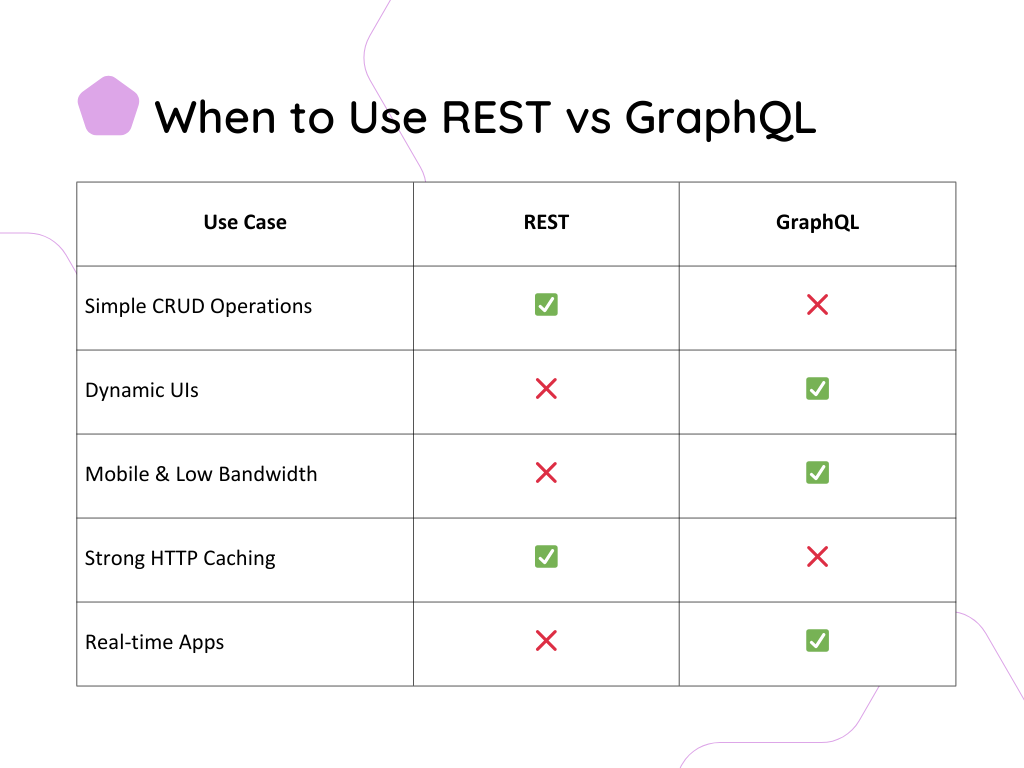
When to Use REST vs GraphQL in 2025

Here’s a quick cheat sheet:

Hybrid Approach: The Best of Both Worlds

Sometimes, you don’t need to choose one over the other. A hybrid approach can work wonders:

  • Use REST for core backend services.

  • Use GraphQL for frontend gateways or aggregation layers.

This flexibility gives teams the performance of REST with the flexibility of GraphQL, where it matters most.

Real-World Example

Let’s say you're building a web app that allows users to manage projects, tasks, and files.

  • With REST, you'd need multiple endpoints: /projects, /tasks, /files, etc.

  • With GraphQL, you can fetch everything with one query: user { projects { tasks { files } } }

This reduces network calls and improves performance on slower networks.

Final Thoughts: What Should You Use in 2025?

Here’s the honest answer: it depends on your use case. But the trend is clear: modern development workflows are leaning toward GraphQL for flexibility, especially in front-end driven ecosystems.

However, REST remains reliable, easier to set up, and perfectly suited for a wide range of applications.

So before choosing, ask yourself:

  • Who is the consumer of this API?

  • What type of data will be fetched?

  • How often will the schema change?

If your app requires custom data shaping, fewer calls, and rapid iteration, consider a full-stack development approach that embraces GraphQL in the frontend while retaining RESTful services in the backend.

Quick Recap

  • REST is rock solid and widely supported.

  • GraphQL is modern, powerful, and suited for complex UI needs.

  • A hybrid architecture could give you the best of both.

  • Choose based on data needs, developer experience, and application complexity.

Still on the fence? Talk to a tech partner who understands both. It could save you months of rewriting and headaches.


UX Red Flags: Why Users Drop Off During Onboarding

  The first few minutes a user spends in your app or product are make-or-break. Onboarding UX isn’t just about tutorials and tooltips; it’s...